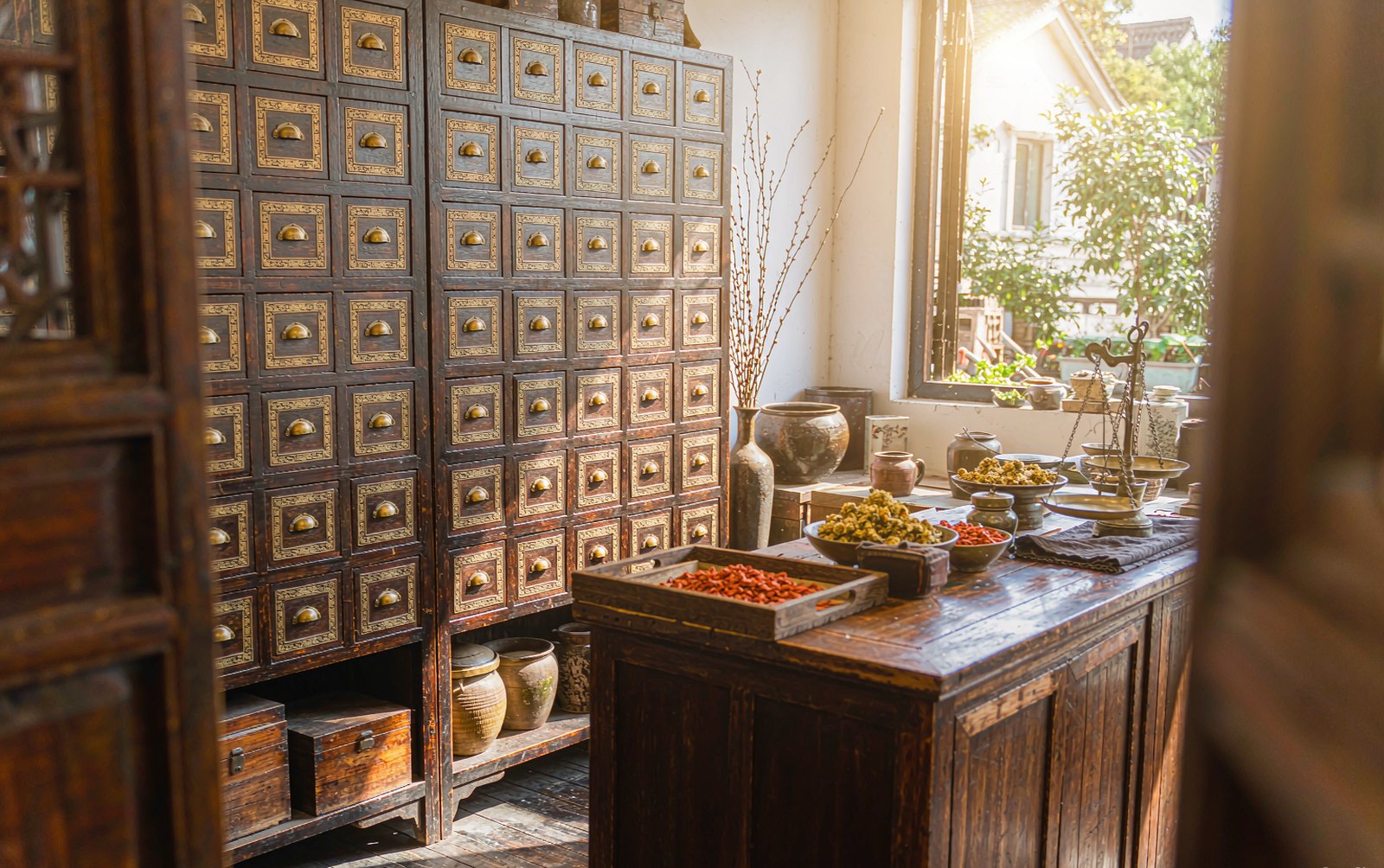
The four qi and five flavours tell you what a medicine does; channel entry (归经) tells you where it goes to do it — to the heart, lung, spleen, liver, or kidney, and to one of the twelve meridians. Bias determines direction; channel entry determines destination.
Channel entry is not an anatomical claim that a drug enters a particular organ; it means that this medicine most clearly regulates a particular functional system or meridian.
Acrid, sweet, warm. In the heart channel it warms and frees heart yang, treating chest tightness, palpitations, and an irregular, knotted pulse; in the lung channel it supports defensive qi and releases the exterior to disperse cold, treating aversion to wind and nasal congestion; in the bladder channel it assists qi transformation, treating retained fluids and difficult urination.
It does not simply “warm” in a general way: it delivers its warmth to three precise places — where yang qi is insufficient in the chest, where defensive qi will not open at the surface, and where transformation has stalled in the lower burner. This is exactly how Guizhi Tang treats taiyang wind-strike.
Salty, cold. Its main work is in the liver and the network vessels: it clears heat and settles fright, extinguishes wind and stops spasms, treating high fever with convulsions; being mobile and penetrating it opens the meridians, treating post-stroke hemiplegia, numbness of the limbs, and painful obstruction of the joints; entering the bladder it calms wheezing and promotes urination.
It does not “clear heat at random”: it carries the penetrating force of salt and cold to the place where liver wind stirs within and the meridians are blocked.
| Medicine | Nature | Channel entry and use |
|---|---|---|
| Huanglian (Coptis rhizome) | Bitter, cold | Heart and stomach channels — clears restless heat in the heart, mouth and tongue ulcers, and stomach-fire vomiting |
| Huangqin (Scutellaria root) | Bitter, cold | Lung and gallbladder channels — clears lung-heat cough and the bitter taste of lesser yang |
| Huangbai (Phellodendron bark) | Bitter, cold | Kidney and bladder channels — clears damp-heat in the lower burner, vaginal discharge, dark urine |
Three identical fire extinguishers, one placed in the heart, one in the lung, one in the basement. To remember only “clears heat” and ignore channel entry is to put out the fire in the wrong room — useless at best, and at worst damaging the place you meant to protect.
| Dimension | What it answers | Guizhi | Dilong |
|---|---|---|---|
| Four qi | Cold or warm | Warm | Cold |
| Five flavours | Tendency to disperse, gather, tonify, or drain | Acrid, sweet | Salty |
| Channel entry | Which organs and meridians it acts on | Heart / lung / bladder | Liver / network vessels / bladder |
| Direction | Up or down, out or in | Rises and floats, releasing the exterior | Penetrates and moves downward |
Some medicines do not attack at all; they only show the road. These are guide medicines (引经药): guizhi leads medicine into the heart channel, chaihu into lesser yang, niuxi leads it downward into the lower burner, jiegeng carries it upward into the chest and diaphragm. The chief herb in a formula is the main force; the guide is the navigation — without it, however strong the troops, they scatter through the whole body and never strike the point.
For a million years humans lived in primeval forest without hospitals, antibiotics, or fever reducers. What kept us alive? The body itself.
Immune response, temperature regulation, inflammation, wound healing, mucosal barriers, gut flora — this whole network of defence and repair is precision engineering honed by hundreds of millions of years of natural selection. Every generation that reached reproductive age and passed on its genes did so because of it.
In plain terms: your body has its own defences, and if a pathogen gets in, some link has come loose. Chinese medicine does not stand in for the body; it tightens the link that slackened.
The medicine fires the pistol; the running is done by your own body. You call out “time to get up” — the person who rises and works is not your voice doing the work for them.
Because outside force is so convenient. Fever: a fever reducer presses the temperature down — though the body was raising it to kill bacteria. Inflammation: antibiotics destroy the bacteria — without asking why they got in. Insomnia: a sleeping pill forces a shutdown — while the heart and kidney not communicating, the liver fire, the anxiety are all still there. Pain: an analgesic screens the signal — while the problem stays.
Every time outside force takes over a job the body should do itself, that capacity is used once less and atrophies a degree. A cast on a broken bone is right — but once it comes off you still have to train the muscle; lean on a crutch for a lifetime and the leg really is lost.
In emergencies, severe illness, when the body truly cannot hold out, outside force saves lives and should be used. But in daily care and the management of chronic conditions the direction should be: let the body learn again to do its own work.
| Situation | Replacement by outside force | What Chinese medicine wakes |
|---|---|---|
| Cold with fever | A fever reducer presses the temperature down | Induce sweat and release the exterior, letting the body push the pathogen out itself |
| Recurrent infection | Round after round of antibiotics | Regulate spleen and stomach, support upright qi, make the terrain unfit for it to breed |
| Insomnia | Sleeping pills force unconsciousness | Harmonise heart and kidney, free the liver and calm the spirit — learn to fall asleep again |
| Chronic fatigue | Energy drinks and every kind of supplement | Nourish spleen and stomach, sleep early, move gently, let yuanqi (元气) grow back on its own |
| Raised blood pressure | Lifelong medication and watching the numbers | Regulate liver yang, transform phlegm-damp, open the meridians, let qi and blood return to place |
The wrong idea of exercise: squeezing yourself dry every day, marathon-style overdraft, muscles hard, joints clicking, heartbeat erratic — training until you are more irritable, sleepless, hypertensive.
The Chinese view: stop at a light sweat; let qi and blood move without spending yuanqi; stay soft and loose, and keep breathing.
Recommended: baduanjin (the Eight-Section Brocade), taiji, the Five Animal Frolics, slow walking, standing post, stretching.
The mark of a good body is not the size of a muscle but likeness to an infant — sinews soft, belly warm, sleep deep, waking quick, emotions without silt.
The five zang organs (五脏) are no black box; they report for duty every day. The five colours, the five tissues, the five openings, the five flavours, the five emotions — learn to look and to listen, and the body will tell you where the trouble is.