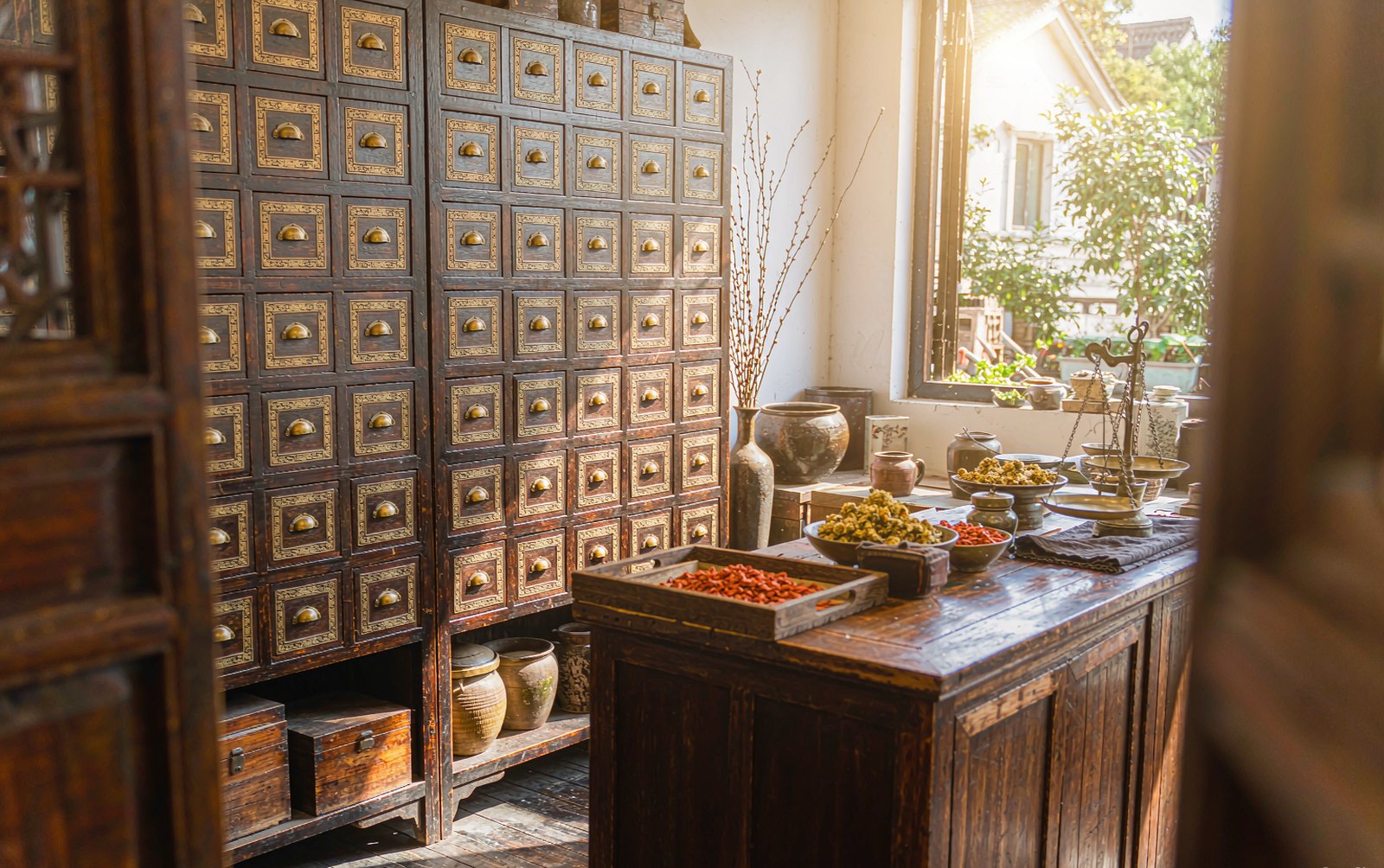
The Daodejing (道德经) says, “Man follows earth; earth follows heaven.” Chinese medicine never treats the body as a machine. It sees a person as a miniature of heaven and earth: whatever exists in the outer world has its counterpart within.
| Heaven and earth | In the body | What it does in the body |
|---|---|---|
| The sun | Heart | Heart yang is like the sun: it warms the whole body, moves qi (气) and blood, and governs the spirit. Without this sun, the limbs go cold and the mind grows dull |
| The atmosphere | Lung | The lung is the canopy of air over the body: it governs breathing, keeps the rhythms of the body, and opens the water passages — drawing in the clear and breathing out the turbid, and spreading fluids through the whole body |
| The land | Spleen and stomach | Spleen and stomach are the earth beneath us: they receive the five grains, transform them into essence, and carry all things. Poor soil grows nothing |
| Rivers and heat beneath the ground | Kidney (the gate of life) | The kidney is the watercourse underground and the heat of the earth — fluid metabolism depends on it, and the fire of the gate of life is stored within; it governs storage and governs strength |
| Trees and the growth of all things | Liver | The liver is spring wood: it governs free flow, governs rising, stores blood, and nourishes the sinews. When liver qi flows freely the qi of the body opens like vegetation; when it is depressed it is a tree pinned down, its branches knotted |
This is not rhetoric but the plain sense of the Neijing and its method of “resonance by image” (取象比类): the heart is the sun within yang and opens to the qi of summer; the lung is the root of qi and opens to autumn; the kidney governs hibernation, is the root of storage, and opens to winter; the liver is lesser yang and opens to spring; spleen and stomach are the root of the granary and open to the qi of earth. Each of the five organs holds one season and one climate — the human body is a stretch of heaven and earth packed into a skin.
Sun on the land → moisture rises as cloud → cloud meets cold and falls as rain → rain enters the rivers and seeps underground → the heat below lifts the water again. In the body it is exactly the same:
So: if the heart is not warm, the whole body is cold; if the lung does not open, the chest feels tight, the skin dries, and the water passages fall into disorder; if spleen and stomach do not transport, no essence is made and the soil cakes hard; if the kidney does not store, the granary leaks and the family capital drains away; if the liver is not at ease, the force of life knots up — and the person grows tense, quick to anger, with tight sinews.
What yin and yang are: substance and motive force
Yin takes form; yang transforms into qi (阴成形,阳化气). Yin (阴) is substance — the body, the blood, the body fluids (jinye, 津液): the visible, tangible capital. Yang (阳) is energy — vitality, warmth, function: the motive force that drives everything. Together they form the basis of life: yin supplies yang with fuel, and yang fills yin with vitality.
Substance and energy must balance. Deplete either side and the scales of life tip: a deficit of substance is yin deficiency (阴虚), a weakening of energy is yang deficiency (阳虚). Read yin and yang, and you hold the first key to Chinese medicine.
What Chinese medicine does: correcting imbalance
Treat cold with heat; treat heat with cold. Chinese medicine is not “treat the head when the head aches”: it corrects an imbalance of yin and yang — nourishing yin (滋阴) where yin is deficient, supporting yang (扶阳) where yang is deficient; moving qi where qi stagnates, invigorating blood where blood is static; treating cold with heat, heat with cold.
Herbs, acupuncture, daoyin (导引, guided stretching and breathing), diet, and the rhythm of rest are all tools for restoring balance. When the body returns to balance the symptoms subside of themselves: what is treated is the person, not merely the disease.
A person is a pot on the fire: below, the fire of the gate of life (命门之火, kidney yang) lifts true yin upward as vapour; in the upper burner it meets the lung and the air, condenses like water in a cold sky, and falls back into the kidney, completing a circuit.
This is the water cycle of heaven and earth projected into the body: sun on the land → water evaporates → cloud forms → cold turns it to rain → it returns to the earth.
A healthy person is one in whom this circuit runs clear:
How many people today are the second kind? Cold feet, a cold lower back — yet spots on the face, a swollen head, insomnia, irritability. This is not “excess fire” but minister fire out of its place (相火不归位): nothing burns below to raise the steam, so empty yang floats upward.
The Lingshu (灵枢) says: “Morning is spring, noon is summer, sunset is autumn, midnight is winter.” A day is not twenty-four hours of work time but a cycle of spring growth, summer flourishing, autumn harvesting, and winter storage.
| Time | Season | What the body should be doing |
|---|---|---|
| Morning, 5–9 | Spring | Rise, open up, walk, take in the daylight |
| Late morning to afternoon | Summer | Work, concentrate, sweat a little |
| Evening, 17–21 | Autumn | Gather the mind, do less, eat slowly, contend with no one |
| Night, from 21 | Winter | Switch off, sleep, no screens, spend no yang |
In one line: day is yang — wake; night is yin — store. Lying in bed past dawn presses down the liver qi; being wide awake at midnight forces the kidney essence to leak away.