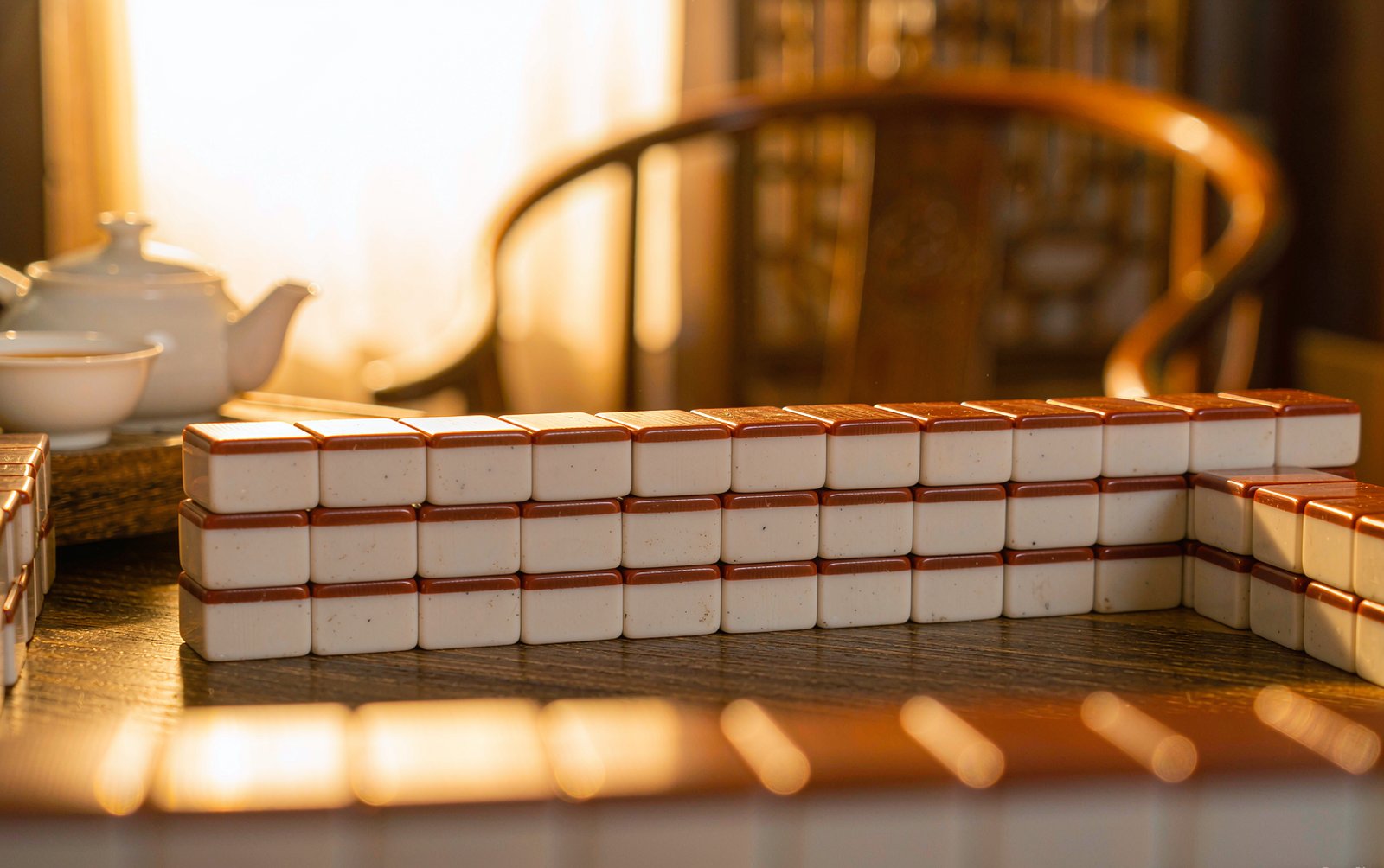
From the alley to the drawing room, from market traders to poets and premiers — this is the most distinctive social language China has ever invented.
A jianghu played out on a tabletop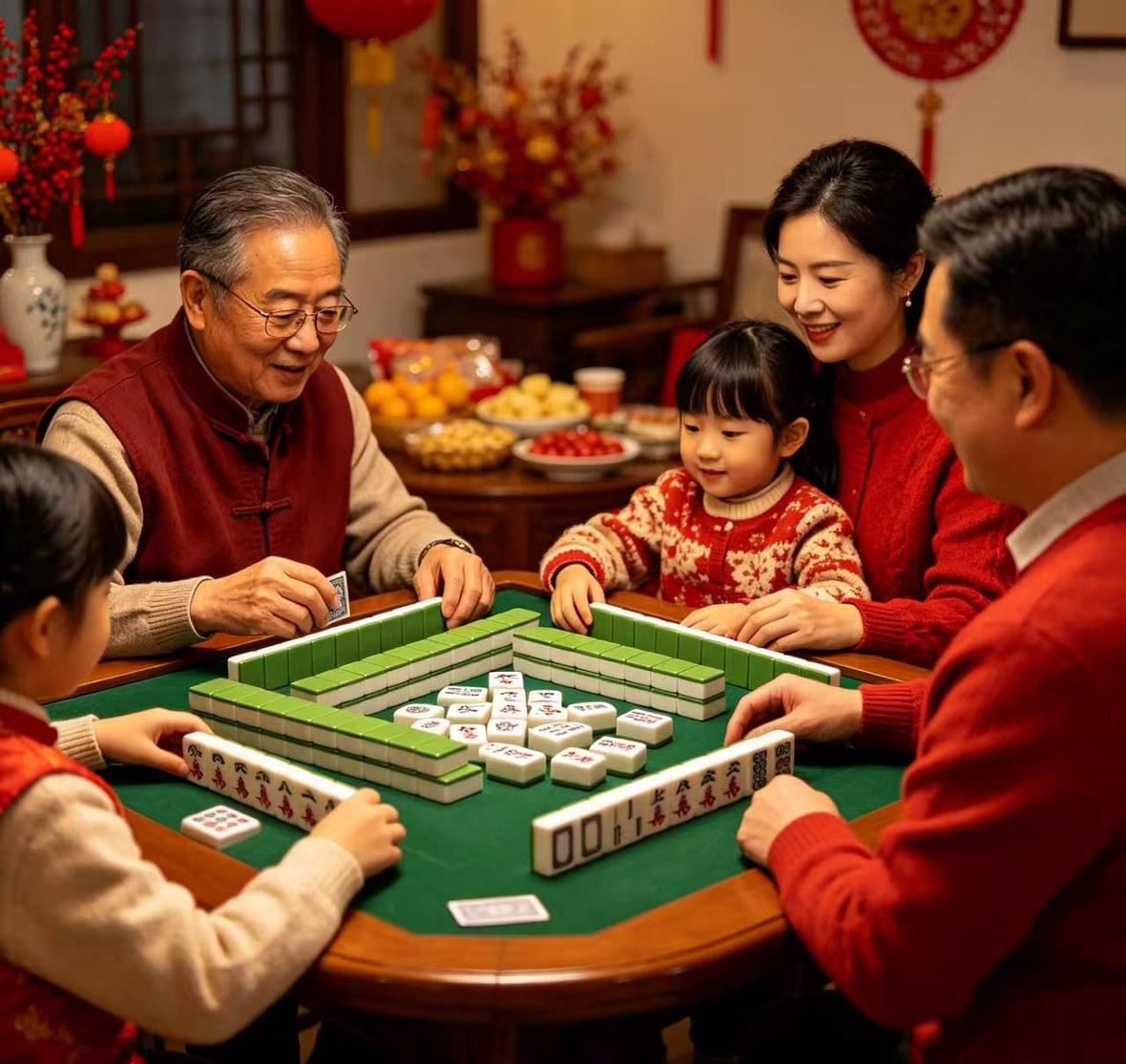
Mahjong is the only amusement in China that cuts across class, age and region. Retired uncles in the hutong, white-collar staff in office towers, even cadres in government bureaus — a table assembled at the weekend is entirely unremarkable. At the table there are no job titles, only the player to your left and the player on your right.
A great many Chinese decisions are reached across a mahjong table. Not because deals are transacted there, but because the game naturally creates an equal, relaxed, sustained encounter — four people face to face for two or three hours builds trust faster than any banquet. One round with a prospective partner teaches you more about them than three days of meetings.
Mahjong is not merely a game of chance. Counting tiles, reading discards, reading faces, choosing what to let go — strong players play probability and psychology. That is why it appeals equally to scholars and to labourers: every player finds their own level of pleasure in it.
Going home for Spring Festival and three generations gathered around one table is the classic image of countless Chinese households. Grandparents teach the grandchildren the tiles, the parents' generation offers advice from the side, and whoever loses peels oranges for the winner. Mahjong gives a family something concrete to do together, instead of everyone scrolling alone.
One to nine of characters, 36 tiles. Each face is engraved with a Chinese numeral.
One to nine of circles, 36 tiles. The faces are rings of dots, drawn after the old copper coin.
One to nine of bamboo, 36 tiles. The faces show joints of bamboo; the One of Bamboo is drawn as a small bird.
Four each of the winds — East, South, West, North — and four each of the dragons — Red, Green, White. Twenty-eight tiles in all.
A standard set runs to 144 tiles. Everyday play uses 136, with the flower tiles set aside.
This is the deep structure of every mahjong variant; the rules change, the skeleton does not.
Three consecutive tiles in one suit, such as two–three–four of characters.
Three identical tiles, such as three East winds.
Four identical tiles; it counts as a single set, and you draw a replacement tile once it is declared.
Two identical tiles. A winning hand must hold exactly one such pair.
1-2-3 Characters + 4-5-6 Circles + 7-8-9 Bamboo + East East East + Green Green → hu!
Read it back: three sequences, one triplet and a pair of dragons — a textbook winning hand.
Seven Pairs (七对子): seven pairs and you are out; no sequences or triplets required.
Thirteen Orphans (十三幺): one and nine of each suit, one of each wind and dragon, and any one of them doubled for the pair. Among the hardest hands in the game.
All tiles are turned face down and mixed. Each player stacks eighteen piles — thirty-six tiles — in front of them, until the four sides close into a square wall.
Dice decide who deals — the East seat. The dealer's roll also decides where the wall is breached and dealing begins.
The dealer takes fourteen tiles, the other three take thirteen. Play moves counter-clockwise.
On each turn a player draws one tile from the wall and discards one they do not need. And again.
A tile discarded by another player may be claimed for a peng (triplet) or a kong (quad); the tile thrown by the player to your left may be claimed for a chi (sequence).
You are a single tile short of a complete hand — the ready state, tenpai.
The hand completes and you call "hu!" to settle. A self-drawn win is paid by all three opponents; a win taken off a discard is paid by the discarder alone.
| Move | How it is used | Rule |
|---|---|---|
| Draw (摸) | Take a tile from the wall | Your own turn, once per round |
| Discard (打) | Throw out one unwanted tile | Face up in the centre, for all to see |
| Chi (吃) | Complete a sequence with the discard of the player on your left | May be claimed only from your left-hand player |
| Peng (碰) | Complete a triplet from any player's discard | Outranks chi; call "peng!" |
| Kong (杠) | Four identical tiles | Exposed or concealed; draw a replacement tile |
| Tenpai (听) | One tile from winning | Need not be declared — a silent ready hand |
| Hu (胡) | The hand is complete | Call "hu!" — the highest claim of all |
Hu > Kong > Peng > Chi
If one player wants to peng while another wants to chi, the peng prevails. If anyone can win, the win overrides everything.
Self-draw (自摸): the tile you draw yourself completes the hand → all three opponents pay a share.
Deal-in (点炮): the tile you discard completes someone else's hand → you pay alone, and never hear the end of it 😂
Promulgated by the General Administration of Sport in 1998: 144 tiles including flowers, and 81 scoring patterns — pure one-suit, all triplets, the Big Three Dragons among them. For players who want a regulated competition.
136 tiles, no flowers. Even the humblest "chicken hand" wins, and payouts are capped. Loose, forgiving rules — the best possible choice for family gatherings and first-timers.
108 tiles, no honour tiles: every player must declare a "missing suit" and play without it. Winners do not leave the table — the rest play on until all have won or the wall runs dry. Kongs carry their own side-scoring, nicknamed "wind and rain". The most popular game in Sichuan and Chongqing: fast, confrontational, unforgiving.
Japan's own descendant of Chinese mahjong, which prizes the closed hand — no peng, no kong — and lets a player declare riichi to announce a ready hand. Dora bonuses and furiten penalties give it a sharp tactical identity; it thrives among younger players overseas.
Sixteen tiles in hand, three more than the mainland game; flowers count toward the score, and the dealer may hold the deal. Longer rounds, deeper strategy.
Nowhere in China will you find another pastime that seats a retired factory worker, a university professor, a company owner and a government official at one table without a flicker of awkwardness. It is a naturally de-stratified space: four players sit down, not four ranks.
For Chinese business, a banquet is too formal and a teahouse too loose; the game room is exactly right. Mahjong supplies hours of face-to-face interaction, threaded with small talk, jokes, probing and alliance — many a partnership, appointment, even a marriage introduction has been talked into being over tiles. This is not corruption but culture: Chinese trust is built in informal settings.
Home for Spring Festival with nothing to say to your parents? Play mahjong. Not sure how to sit with your elders? Play mahjong. Across the table the generational gap is diluted by the sound of shuffling. Grandfather teaches the grandson the tiles, aunts trade family news between discards, the winners laugh and so do the losers. Mahjong makes going home concrete, and warm.
Mahjong rehearses a particular intelligence: holding the whole board and the single move at once, deciding under uncertainty, reading other players' discards to infer what remains unseen. That habit of locating certainty inside ambiguity is the same logic Chinese bring to relationships and to intractable situations.
Since it reached the West in the 1920s, mahjong has acquired leagues, clubs and online platforms around the world. After kung fu and Chinese food, it is one of the Chinese cultural symbols foreigners know best — and for many, the wish to read the characters on the tiles is the first reason they took up Chinese.
From Grandmother Jia dealing cards to her granddaughters in Dream of the Red Chamber, to the petit-bourgeois tables of Lao She's Beijing, to the mahjong scenes of contemporary film — the game has long been standard furniture in Chinese narrative, carrying the country's philosophy of living and its unspoken social grammar.
🀄 Take a seat. The table is set, and China is waiting for you there.